

You queued up the week’s posts on Sunday night so the week would run itself. By Wednesday you’re opening Instagram, LinkedIn and Facebook one at a time, checking that each post went out. As a community manager wrote on Capterra, “Sometimes I wish I could preview exactly how it looks per platform before it posts, so I still go back and forth which kinda wastes the time I just saved.”
The catch is that “automation” covers several jobs: publishing on a schedule, drafting captions, answering DMs and comments, sending reports and moving data between apps. Most tools do one or two of those well.
So, we sorted 9 social media automation tools by what they actually take off your hands, from all-in-one suites and publishing-first schedulers to DM automation and workflow connectors.
What Social Media Automation Tools Actually Automate
Social media automation tools take five separate jobs off your plate: publishing, drafting, replying, reporting and moving work between people and apps. Each job also has a part that should stay with a person, and the table below splits the two.
The Five Jobs You Can Hand to Software
| Job | What the tool automates | What should stay human |
| Publishing | Bulk uploads, posting queues and time slots, evergreen recycling, RSS auto-posting | Timely or reactive posts, and pausing the queue during a crisis |
| AI content | Caption drafts, hashtags, platform variations, repurposing | The final edit and brand voice sign-off |
| Conversations | Inbox routing, saved replies, DM and comment auto-replies, review replies | Complaints, sensitive replies, anything public and heated |
| Reporting | Scheduled and white-label reports, auto-delivery to clients | Reading the numbers and deciding what changes |
| Workflows | Approvals, cross-app triggers (Zapier, n8n), API and MCP connections | Deciding who approves what, and checking that things ran |
Read the right-hand column as the list of things not to automate. If a tool on this list promises to take one of those off you too, be suspicious of that promise.
Social Media Automation Tools at a Glance
Paid entry plans on this list start at $5 a channel (Buffer) and run up to $99 a user (Hootsuite), all on annual billing. How a tool bills matters as much as where it starts, because automation usually sits a tier or two above the entry plan.
Here are all 9 compared tools side by side.
| Tool | Best For | Pricing Model | Entry Price | G2 Rating |
| SocialPilot | Teams of 3 to 6, agencies up to 25 client accounts | Flat per plan | $25.50/mo | 4.5/5 |
| Sendible | Agencies running 3 to 7 client brands | Per plan, unlimited users | $30/mo | 4.5/5 |
| Agorapulse | Large teams and enterprises working from a shared inbox, up to 10 profiles. | Per user | $79/user/mo | 4.5/5 |
| Sprout Social | Teams of 10+ handling high message volume | Per seat | $79/seat/mo | 4.4/5 |
| Hootsuite | Enterprise teams of 10+ needing monitoring and ads | Per user | $99/user/mo | 4.3/5 |
| Buffer | Solo marketers on 3 to 5 channels | Per channel | $5/channel/mo | 4.3/5 |
| SocialBee | Solopreneurs and small businesses on up to 10 profiles | Flat per plan | $24.20/mo | 4.7/5 |
| ManyChat | Creators and brands selling through DMs | Per plan, sized by active contacts | $14/mo | 4.5/5 |
| Zapier | Teams sending posts from a CMS, form or spreadsheet | By task volume | $19.99/mo | 4.5/5 |
Entry prices are monthly rates on annual billing, as checked on each vendor’s pricing page in November. Vendors change plans without notice, so confirm on the pricing page before you buy.
All-in-One Automation Suites
These five suites automate publishing, inbox triage and reporting from one login, so a post, the replies it gets, and the report on how it did never leave the tool. Start in this group if you’d rather pay for one subscription than wire three separate tools together.
1. SocialPilot – Best for Agencies and Small Businesses
Your month of posts, approvals and client reports can run itself on one flat-priced plan, and the Social Inbox can auto-reply to routine DMs and comments too.
Platforms Supported: Facebook, Instagram, X (Twitter), LinkedIn, TikTok, YouTube, Pinterest, Threads, Bluesky, and Google Business Profile.
Key Features:
- Bulk scheduling of up to 500 posts by CSV (Premium)
- Posting queues with recurring time slots per account
- RSS feed automation that publishes new items from sources you pick
- AI Pilot for captions, hashtags and post variations
- Manager approval (Standard) and client approvals with Approvals On-The-Go (Premium)
- White-label PDF reports delivered on a schedule (Premium)
- MCP server to run SocialPilot from Claude or ChatGPT (every paid plan)
- Social Inbox automation with Auto Reply to a DM, Auto Reply to a Comment and Auto DM for a Comment (Instagram only)
What it looks like: In SocialPilot, you open the content calendar and pick List, Day, Week or Month. In Month view you see every connected account’s posts on one grid, a crowded day folds into a “+X more” link, and you drag any post to a new day to reschedule it. Open the composer and AI Pilot drafts the caption, hashtags and variations for each network. If you work from Claude or ChatGPT, you add the SocialPilot MCP server as a connector, sign in, and ask the assistant to create, schedule or review posts, or to flag the ones that didn’t go out.
Shayne W., a G2 reviewer, wrote: “Basically 4 hours of work allows me to keep constant communication for an entire month which has proven invaluable for us as a business who does not employ internal marketing.”
On G2, SocialPilot is rated 4.5 out of 5 across 846 reviews.
What it does well: A month of posts goes in as one CSV and lands on the content calendar, where you can see every account’s schedule at once, and approvals run manager first, client second. From Premium, client seats are unlimited and a client approves or sends back a post from an email link, with no password to remember.
SocialPilot’s Essentials costs $25.50 a month billed annually ($30 month to month) for 1 user and 7 accounts, with no analytics, inbox or approvals. Standard, at $42.50 annually or $50 monthly, covers 3 users and 15 accounts and adds the Social Inbox, PDF reports and manager approval. Premium runs $85 or $100 for 6 users, 25 accounts, unlimited client seats, client approvals, bulk scheduling by CSV and white-label reports. Ultimate costs $170 or $200 for 50 accounts and unlimited users, and Enterprise is quote only.
Billing is flat per plan, so the bill moves only when you add a user ($5 a month on Standard and Premium) or an account ($4 a month on Essentials, Standard and Premium). There’s no free plan, and the 14-day free trial needs no credit card. See SocialPilot’s plans for current details. For automation, Premium is the tier to pick, because CSV bulk scheduling, client approvals and scheduled white-label reports all start there.
2. Sendible – Best for Marketing Agencies
On Sendible’s $30 Core plan, an evergreen queue can recycle the same posts while an RSS feed keeps topping it up, though nobody signs off on what goes out until Plus.
Platforms Supported: Facebook, Instagram, X (Twitter), LinkedIn, TikTok, YouTube, Threads, Bluesky and Google Business Profile.
Key Features:
- Evergreen Content Queues with recycling (10 queues on Core, unlimited on Elite)
- RSS Auto Poster on every plan
- Bulk scheduler and CSV uploads on every plan
- Unlimited AI credits on every plan
- Post approvals (Plus) and custom approval workflows (Premium)
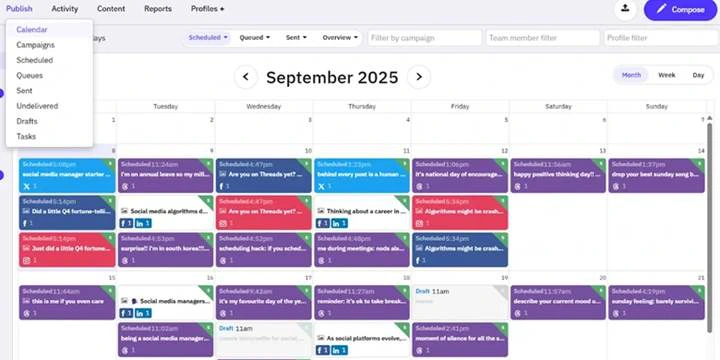
What it looks like: In Sendible, you open Publish and land on Calendar, where Month view lays out every post by day with its status, For Approval, Draft or Scheduled. From there you click Queues in the left menu, beside Campaigns, Failed and Drafts, add evergreen posts to a queue, set the days and times it publishes, and turn on recycling, so each post moves to the back of the line once it’s sent. When the queue runs thin, you hit Compose and write a new one.
Maggie B., a G2 reviewer, wrote: “I like how easy it is to schedule posts and let everyone on my team see what is going on!”
On G2, Sendible is rated 4.5 out of 5 across roughly 900 reviews.
What it does well: Recycling queues, the RSS Auto Poster and CSV uploads all come on Core, so one brand can keep a steady evergreen schedule before paying for anything else. Each client or location also gets its own workspace.
Sendible’s Core costs $30 a month billed annually or $35 monthly for 1 workspace and 6 social profiles. Plus, at $84 or $99, gives 3 workspaces, 18 profiles and approvals. Premium runs $169 or $199 for 7 workspaces, 42 profiles and custom branded reports. Elite costs $254 or $299 for 15 workspaces and 90 profiles, and Enterprise $638 or $750 for 50 workspaces and 300 profiles, with a quote-only tailored plan above that.
Billing is per plan with unlimited users, so a five-person team on Core still pays $30 a month on annual billing. There’s no free plan, but the 14-day free trial needs no card. See our Sendible pricing guide for current plans. For automation, Plus is the tier to start on, because it puts an approval step in front of what your queues and RSS feeds publish.
What running Sendible standalone requires: Plus, at $84 a month billed annually, before anyone reviews what a queue publishes, because Sendible assigns posts for approval only on Plus and above. Core also caps you at 10 queues. If either rules it out, our Sendible alternatives list covers the options.
3. Agorapulse – Best for Large Teams and Enterprises
The inbox is where Agorapulse automates, and below the quote-only Custom plan you get one rule to do it with.
Platforms Supported: Facebook, Instagram, X (Twitter, paid add-on), LinkedIn, TikTok, YouTube, Pinterest, Threads, Bluesky and Google Business Profile.
Key Features:
- Automated moderation rules that review, assign, label, hide or delete items (1 rule on Standard to Advanced, unlimited on Custom)
- Unlimited post scheduling on every plan
- Post and inbox assignments (Professional)
- Shared content calendars (Advanced)
- AI-powered reply suggestions (Custom)
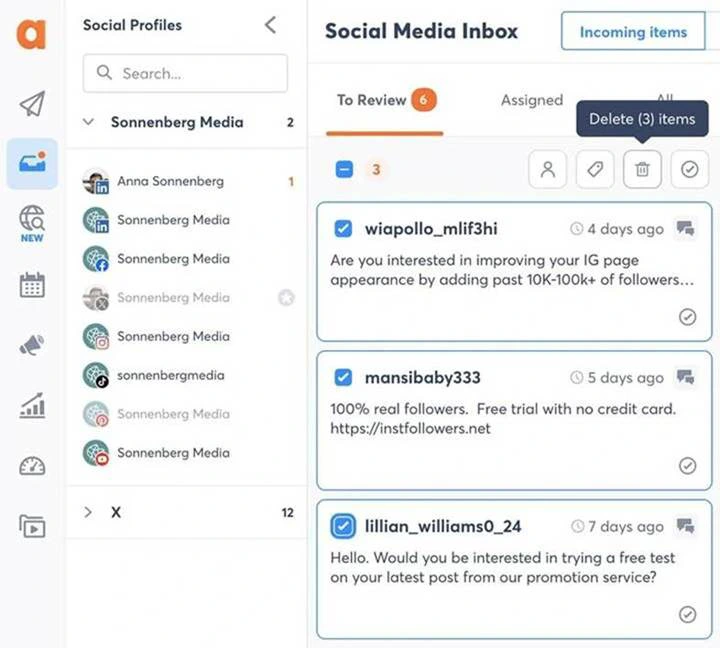
What it looks like: In Agorapulse, you pick a page from the Social Profiles list on the left and its Social Media Inbox opens on the To Review tab, holding every incoming item nobody has handled yet. Tick the spam comments and delete them in bulk, then switch to Assigned to see what a teammate has picked up. To stop doing that by hand, you click the Automated Moderation icon, choose + Create automated rule, name it, pick the profiles and a condition such as a keyword or a link, and add up to six actions, from Label and Assign to Hide.
Ray B., a G2 reviewer, wrote: “I use Agorapulse solely for the inbox feature to keep track of my business social pages. It solves the problem of compiling my multiple business social inboxes in one place. The initial setup was easy, with no problems, and there’s great support if you need it.”
On G2, Agorapulse is rated 4.5 out of 5 across 979 reviews.
What it does well: Items stay in To Review until a person or a rule acts on them, so nothing slips between shifts. A single rule can already hide a comment with a link, label it and assign it in one pass.
Agorapulse charges per user, per month, and every listed plan includes 10 social profiles. Extra profiles cost $10 each a month on annual billing or $15 monthly. Standard is $79 on annual billing or $99 monthly. Professional (adds assignments and simple approvals) is $119 or $149. Advanced (adds shared calendars and ROI reports) is $149 or $199. Custom, with unlimited profiles and multi-step approvals, is quote only.
It has a 30-day trial that needs no credit card, and you can stay on a free plan after it ends. Every person who logs in is billed, so three people on Professional cost $357 a month on annual billing. See our Agorapulse pricing guide for current plans. For automation, Professional is the tier most teams need, since it pairs the automated rule with assignments that route each item to a person.
What running Agorapulse standalone requires: A Custom quote once you need a second inbox rule or a rule with more than one condition, because Standard, Professional and Advanced each allow one automated rule per organization. Pick that rule carefully, since it has to do the work of a whole moderation shift. If that single rule won’t cover your spam, routing, and labeling, our Agorapulse alternatives roundup lists other options.
4. Sprout Social – Best for Enterprises and Multi-Locational Brands
Every extra pair of hands costs $399 a month once you want Sprout’s chatbots and self-sending reports, because both live on Advanced and Advanced bills per seat.
Platforms Supported: Facebook, Instagram, X (Twitter), LinkedIn, TikTok, YouTube, Pinterest, Threads, Bluesky, Google Business Profile, Reddit, Snapchat and WhatsApp.
Key Features:
- Sprout Queue to fill publishing gaps automatically (every plan)
- Bulk scheduling of up to 350 posts by CSV (Professional)
- Message approval workflows (Professional)
- Bot Builder chatbots for X DMs and Facebook Messenger (Advanced)
- Scheduled report delivery by email as a PDF (Advanced)
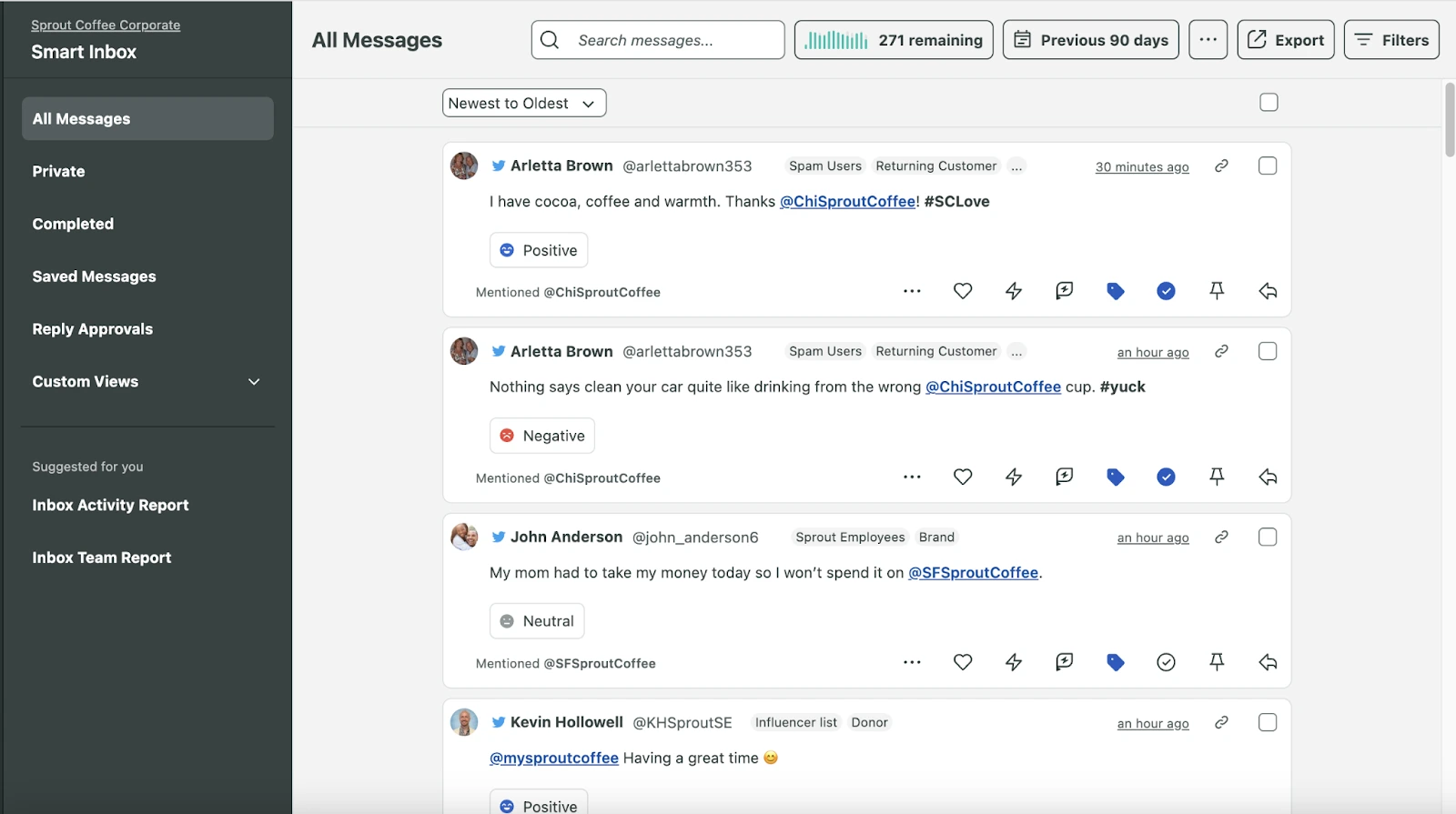
What it looks like: In Sprout Social, you open the Smart Inbox and land on All Messages, where every comment, mention and DM from your connected profiles sits sorted Newest to Oldest. Each one carries a Positive, Negative or Neutral label, so you open Filters and pull up only the negative ones from the Previous 90 days. A reply that needs a second pair of eyes goes to Reply Approvals, and you mark the rest Completed. At the end of the week, you open the Inbox Team Report to see how your team handled the queue.
Joe J., a G2 reviewer, wrote that “The dashboard is super intuitive, the scheduling tools are a lifesaver, and the reporting actually helps me see what’s working without getting lost in data.” But he also added that “it can get pretty pricey, especially if you need access for a larger team.”
On G2, Sprout Social is rated 4.4 out of 5 across 7,588 reviews.
What it does well: ViralPost picks send times on every plan, and the Sprout Queue fills the gaps between scheduled posts, so a small team keeps a steady cadence without timing each post by hand. Trellis, Sprout’s AI assistant, also comes on every plan.
Sprout bills per seat, on annual or monthly billing. Essentials costs $79 per seat a month annually or $99 when billed monthly, with 5 social profiles and no inbox. Standard is $199 a seat a month annually or $249 monthly, Professional is $299 or $399 (unlimited profiles), and Advanced is $399 or $499. Enterprise is quote only. There’s no free plan, but the 30-day trial needs no credit card.
Three people on Advanced, the plan with chatbots and scheduled reports, cost $1,197 a month on annual billing before any add-on. Check our Sprout Social pricing guide for current plans. For automation, Advanced is the tier to pick, because the Bot Builder and scheduled reports only start there, while Professional covers bulk scheduling and message approvals.
What running Sprout Social standalone requires: Advanced for every seat before the Bot Builder can answer a DM or a report can send itself, since Sprout lists both on the Advanced plan only. Listening is still extra after all that. Teams that want the automation without paying for it per person usually start comparing Sprout Social alternatives priced per plan.
5. Hootsuite – Best for Enterprises and Large Brands
Hootsuite hands out its automation one plan at a time, with monitoring on Standard, inbox automation on Professional and routing on Advanced, and each step up is billed again for every person who logs in.
Platforms Supported: Facebook, Instagram, X (Twitter), LinkedIn, TikTok, YouTube, Pinterest, Threads, Bluesky and Google Business Profile.
Key Features:
- Unlimited scheduling with a Recommended time, plus DM automations at Professional.
- Inbox automation (Professional)
- Message assignment and auto-routing (Advanced)
- Approvals for drafts before they publish (Advanced)
- Brand and competitor monitoring (Standard)
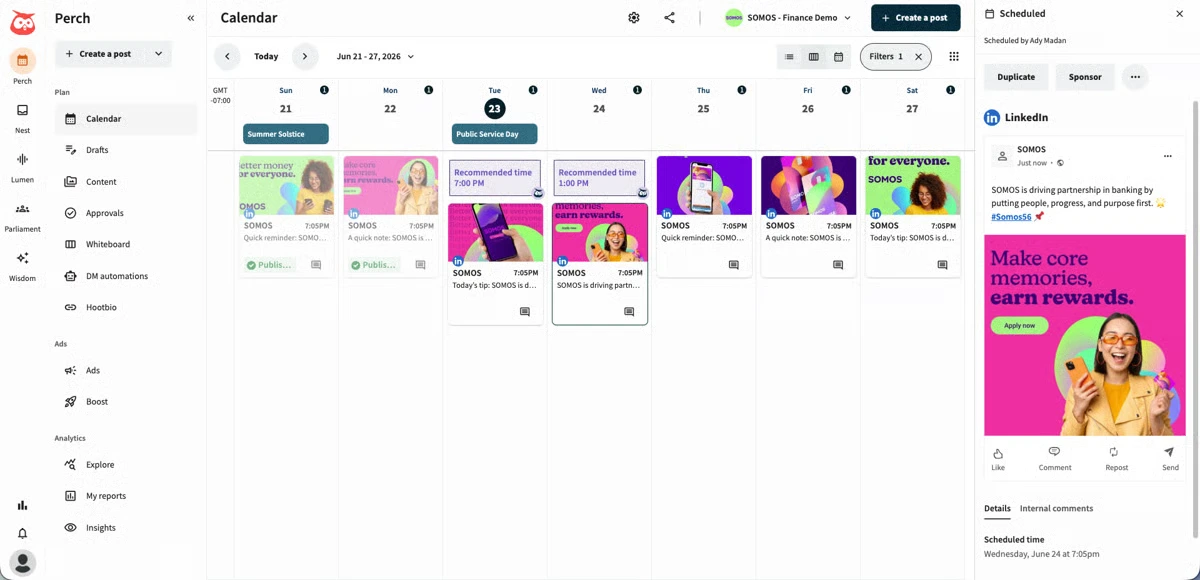
What it looks like: In Hootsuite, you open Calendar under Plan in the left rail and see your week, starting from Today, with Filters to narrow it by network or status. Hit Create a post, write it, and accept the Recommended time or pick your own. Click any Scheduled post and a preview panel opens with Duplicate, Sponsor, Details and Internal comments. When a draft needs sign-off, you go back to the same Plan menu for Approvals and Drafts.
Carlette B., a G2 reviewer, wrote: “There’s not much we dislike about the platform, but it can be expensive and a bit clunky for a small team. Occasionally, the connection to a social media platform drops.”
On G2, Hootsuite is rated 4.3 out of 5 across 7,757 reviews.
What it does well: Brand and competitor monitoring comes on Hootsuite’s entry plan, a tier lower than Sprout puts it, and inbox automation arrives one tier up, so the replies an automated post pulls in can be sorted in the same workspace that scheduled it.
Hootsuite bills per user, and the published rates are for annual billing. Monthly billing exists at a higher rate it doesn’t print. Standard is $99 with 10 social accounts. Professional is $199 with unlimited accounts and custom reports. Advanced is $399 and adds team approvals. Enterprise is quote only, and taxes are extra. There’s no free plan. The 14-day trial caps posting at 10 to 20 posts a day per organization and blocks bulk scheduling.
Because every seat is billed separately, three people on Professional cost $597 a month on annual billing. See our Hootsuite pricing guide for current plans. For automation, Professional is where inbox automation starts, and Advanced is the tier to pick if you also need approvals and auto-routing.
What running Hootsuite standalone requires: Advanced for every person who handles routed messages or approves posts, since auto-routing and approvals only start there. Three people on Advanced cost $1,197 a month billed annually. If routing is the automation you need, set that number against Hootsuite alternatives that include it at a flat plan price.
Publishing-First Schedulers for Automated Social Media Posting
These two automate the part most people mean by “automation”: a post goes into a queue once and goes out on time without you. Neither one replies to people for you, so read them as publishing tools first.
6. Buffer – Best for Solo Entrepreneurs and Creators
Buffer automates the queue and little else, and it charges you per channel to do it, so three networks cost almost nothing while fifteen become a real line item.
Platforms Supported: Facebook, Instagram, X (Twitter), LinkedIn, TikTok, YouTube, Pinterest, Threads, Bluesky, Google Business Profile, Mastodon and Substack.
Key Features:
- Publishing queue with calendar and list views
- Free plan for 3 channels with 10 scheduled posts each
- First comment scheduled with the post (Essentials)
- AI Assistant (included on Free)
- Approval workflows and unlimited users (Team)
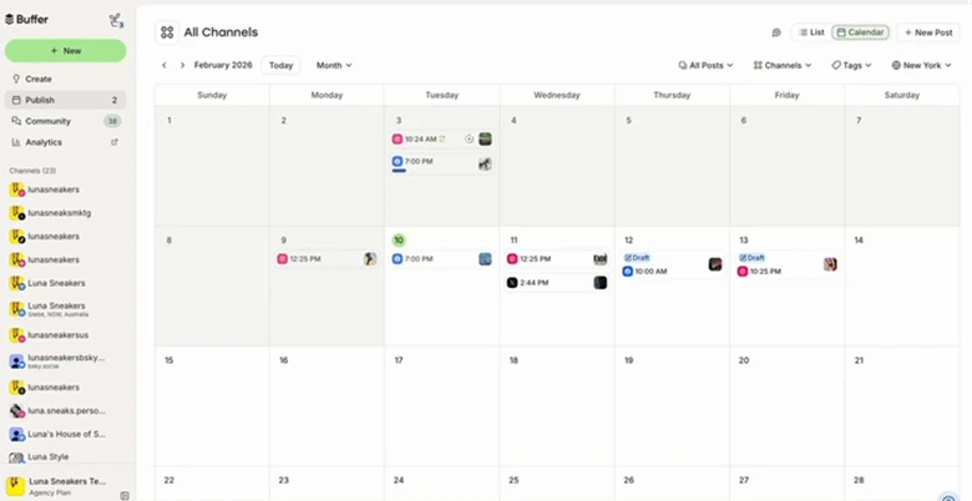
What it looks like: In Buffer, you click Publish in the top bar and land on All Channels in Month view. Flip the List / Calendar toggle to see posts laid out by day, and narrow them with the Channels and Tags filters. New Post opens the composer, and anything you’re not ready to send saves as a Draft. Once posts go out, you switch to Community or Analytics in the same top bar.
Rebecca H., a G2 reviewer, wrote: “It’s made posting to social so much easier. Now I just schedule it once I’ve finished, and then I can forget about it.”
On G2, Buffer is rated 4.3 out of 5 across roughly 1,023 reviews.
What it does well: Scheduling the first comment along with the post means the hashtags or link you’d normally add by hand go out on time too. The community inbox for replies comes on every plan, Free included.
In Buffer, you pay per channel, per month. The Free plan covers 3 channels, 10 scheduled posts per channel, and 1 user. Essentials runs from $5 per channel on annual billing or $6 monthly, for 1 user. Team, with unlimited users and approvals, runs from $10 per channel annually or $12 monthly. From the 11th channel, the per-channel rate drops. Paid plans come with a 14-day free trial.
Because every channel is billed separately, 10 channels on Essentials come to $60 a month on monthly billing. See our Buffer pricing guide for current plans. For automation, Essentials is enough for a solo queue with first comments, and Team is the tier to pick once someone has to approve posts before they go out.
What running Buffer standalone requires: Watching the channel count, because every network you add is another charge, and approvals only arrive on Team at double the per-channel rate. Past ten channels, price the Buffer alternatives that bundle accounts into a flat plan.
7. SocialBee – Best for Solopreneurs and Small Businesses
Evergreen posts that put themselves back in the queue are the reason to pick SocialBee, provided you’re willing to file every post into a category first.
Platforms Supported: Facebook, Instagram, X (Twitter), LinkedIn, Pinterest, TikTok, YouTube, Threads, Bluesky and Google Business Profile.
Key Features:
- Evergreen categories that re-share posts automatically
- Category-based posting schedule
- RSS feeds and content sources sorted into categories
- Bulk editor and CSV upload (Accelerate)
- Post approval (Accelerate)
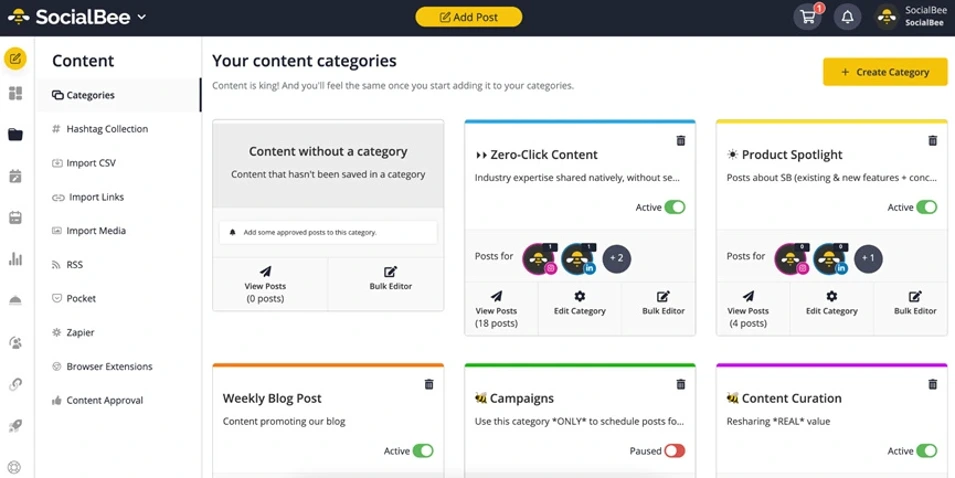
What it looks like: In SocialBee, you open Content, then Categories, where each card has an Active or Paused switch. You set whether a category’s posts are Evergreen, shared again and again, or Share Once. Then you place categories in your Posting Schedule, and each week SocialBee fills each slot from the category it names.
Richie M., a G2 reviewer, wrote: “Sometimes you can’t post IG post and reels at the same time”
On G2, SocialBee is rated 4.7 out of 5 across 479 reviews.
What it does well: Pausing one category stops every post in it, so a seasonal promotion or a product you’ve stopped selling drops out of rotation in one click while the rest of the queue keeps recycling.
According to SocialBee’s pricing page, Bootstrap costs $24.20 a month billed annually ($29 monthly) for 1 user and 5 profiles. Accelerate, at $40.80 annually or $49 monthly, gives 10 profiles and CSV upload. Pro, at $82.50 annually or $99 monthly, gives 25 profiles and 3 users per workspace. A 14-day trial replaces a free plan. For automation, Accelerate is the tier to pick, because CSV upload and post approval both start there.
What running SocialBee standalone requires: Accelerate, at $40.80 a month billed annually, the moment you batch posts from a spreadsheet or anyone else has to sign off a post, because CSV upload and post approval both start there. If a second pair of eyes is part of your routine from day one, compare SocialBee alternatives that include approvals on the entry plan.
DM and Comment Automation
Schedulers stop working the second a post goes live. This category picks up there, answering the comments and DMs a post brings in, usually with a keyword trigger and a private reply.
8. ManyChat – Best for Creators and Brands Selling Through DMs
When someone comments a keyword under your Reel, ManyChat answers in their DMs on its own, but getting the Reel onto your feed is a job for another tool.
Platforms Supported: Instagram, TikTok, Facebook Messenger, WhatsApp (from Pro) and Telegram.
Key Features:
- Comment-to-DM triggers on Instagram posts and Reels (up to 4 live triggers on Free)
- Unlimited custom automations (Essential)
- Scheduled messages and inbox organizer (Essential)
- Broadcasting and Manychat AI conversations (Pro)
- Multi-user inbox (Business)
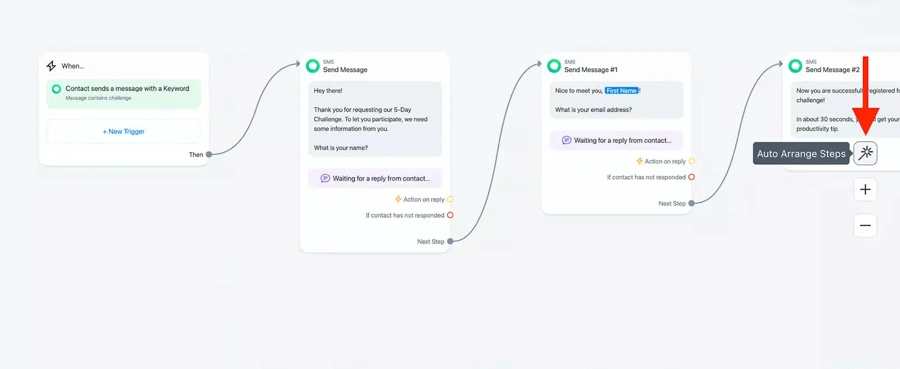
What it looks like: In ManyChat, you build each automation on a visual canvas. A When… card holds the trigger, such as a contact sending a message with a keyword, and you drag Message, Condition, Action and AI blocks onto the map and wire them together. Each Send Message step waits for a reply, with separate paths for Action on reply and If contact has not responded, and Auto Arrange Steps tidies the layout once it gets messy. For a comment trigger, you pick a match type, from Message is (exact) to Message contains, then flip the Set Live toggle.
Travis V., a G2 reviewer, wrote: “How easy it was to set up a bot to learn my business and auto respond and make appointments for me.”
On G2, ManyChat is rated 4.5 out of 5 across 165 reviews.
What it does well: The keyword trigger turns a comment section into a sign-up form, sending the link or guide the commenter asked for without anyone on your team opening the inbox.
ManyChat prices per plan, sized by active contacts, the people you interact with in a month, as listed on ManyChat’s pricing page. The Free plan covers 25 active contacts, 2 channels and 1 user, with up to 4 live triggers and ManyChat branding. Essential costs $14 a month billed annually ($168 a year) or $17 monthly for 250 contacts and 2 users, and unlocks unlimited automations. Pro costs $29 or $39 for 2,500 contacts, 3 channels and 3 users, and adds broadcasting and Manychat AI.
Business costs $69 or $99 for 7,500 contacts, unlimited channels and 5 users, and Advanced costs $139 or $199 for 25,000 contacts and 10 users. Essential and Pro come with a 14-day free trial. For automation, Pro is the tier to pick, because broadcasting, Manychat AI and a third channel all start there.
What running ManyChat standalone requires: A scheduler beside it, because ManyChat works on posts after they’re live and doesn’t plan or publish them. It will happily answer comments on a Reel it had no part in posting. Its own roundup of Instagram automation tools files ManyChat under DM and comment automation and points to separate tools for scheduling.
Workflow Automation Connectors
A connector doesn’t manage social media. It moves information between the apps you already use, so a new blog post, form entry or spreadsheet row can become a social post without anyone copying it across.
9. Zapier – Best for Teams Connecting Social to Their Other Apps
Zapier carries a freshly published blog post to your Facebook Page without anyone pasting it over, and it bills you by the task for the trip.
Platforms Supported: Zapier doesn’t publish anything itself. It passes data to social apps such as Facebook Pages, LinkedIn, Instagram for Business, Pinterest and YouTube, and to schedulers such as Buffer.
Key Features:
- Multi-step Zaps that send one item to several apps (Professional)
- Facebook Pages actions, including Create Page Post and Create Page Post as Draft
- Triggers from WordPress, RSS feeds and Zapier’s own Tables and Forms
- Zap history with run statuses and task usage for every Zap
- Shared Zaps and connections for teams (Team)
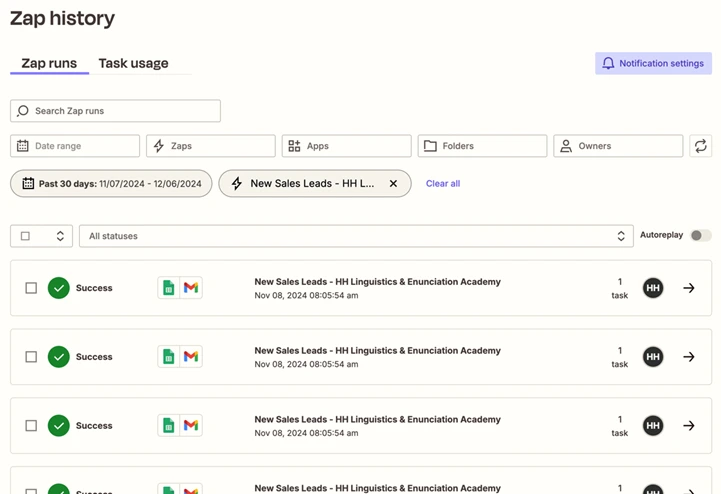
What it looks like: In Zapier, you open Zap history and land on the Zap runs tab, where every run of every Zap is listed with its status, such as Success, the apps it touched, the time it ran and how many tasks it used. You narrow the list with Date range, Zaps, Apps, Folders and Owners, or search runs by name, and the Task usage tab beside it shows how much of your monthly allowance is gone. The Autoreplay toggle and Notification settings sit at the top, so a run that errors can be retried and flagged to you instead of failing quietly.
Amie L., a G2 reviewer, wrote: “Zapier has streamlined workflows for me by eliminating repetitive manual tasks and allowing automation of lead routing, form submissions, CRM updates, and email notifications.”
On G2, Zapier is rated 4.5 out of 5 across 2166 reviews.
What it does well: It reaches the apps a social scheduler never touches, such as your CMS, CRM or form tool, and the Create Page Post as Draft action lets a person check an automated post before it goes out.
Zapier prices by task volume, the monthly allowance of actions your Zaps run, and charges nothing per social account, as listed on Zapier’s pricing page. The Free plan gives you 100 tasks a month and two-step Zaps only.
Professional starts at $19.99 a month billed annually or $29.99 monthly for 750 tasks, with multi-step Zaps, webhooks and AI fields. Team starts at $69 or $103.50 a month for 2,000 tasks and 25 users. Prices on both plans rise as you buy more tasks, and Enterprise is quote only. New accounts get a 14-day free trial of Professional with no credit card. For automation, Professional is the tier to pick, because multi-step Zaps that post to several networks at once start there.
What running Zapier standalone requires: A scheduler or the native apps for everything that happens around the post, since a Zap’s job ends when the data reaches the next app, and the calendar, approval queue and post analytics live in whichever tool it feeds. Budget tasks too, because a busy feed on three networks will outgrow Professional’s entry tier inside a month.
Where SocialPilot Fits In This List
Our own tool sits with the all-in-one suites. It covers all five jobs inside one flat-priced plan, including automated replies to DMs and comments.
On publishing, you get recurring queue time slots, bulk scheduling of up to 500 posts by CSV (from Premium) and RSS feed automation that posts from sources you pick. AI Pilot drafts captions, hashtags and post variations from your plan’s monthly AI credits.
Comments and messages land in one Social Inbox from Standard up, where auto-reply flows can answer DMs and comments for you, and an Auto DM can reply privately to an Instagram comment.
Reports go out as PDFs on a schedule, white-labeled from Premium. For workflows, approvals run manager first and then client, with client approval starting on Premium. A Zapier connection, an MCP server on every paid plan and an API on Enterprise link it to the rest of your stack.
Plans are priced per plan rather than per seat. Essentials costs $25.50 a month billed annually ($30 monthly) for 1 user and 7 accounts. Standard is $42.50 or $50 for 3 users and 15 accounts, Premium is $85 or $100 for 6 users and 25 accounts, and Ultimate is $170 or $200 for 50 accounts and unlimited users.
Where Another Tool Might Be the Better Fit
- Multi-step DM funnels. Our Social Inbox auto-replies to DMs and comments and can send an Auto DM for an Instagram comment. If you want a longer DM sequence with conditions and broadcasts, ManyChat is built for exactly that and runs alongside a scheduler.
- Moving social data into a CRM, form or sheet. Zapier connects a new lead, form entry or spreadsheet row to the rest of your tools, which a social suite on its own won’t do.
- Listening across the web. None of our public plans include social listening. Sprout Social and Hootsuite both include monitoring on their Standard plans and sell deeper listening on top.
- Evergreen recycling as your whole strategy. If your calendar is mostly the same posts rotating by category, SocialBee is organized around content categories that refill the queue on their own.
How to Choose the Right Social Media Automation Tool
Decide which of the five jobs you actually want off your plate, then buy the cheapest setup that covers those and nothing else. For most teams that means a scheduler plus one specialist tool.
Match the Tool to the Jobs You Need Automated
| Team type | Publishing | AI content | Conversations | Reporting | Workflows |
| Solo founder | Essential | Optional | Not needed | Not needed | Not needed |
| In-house coordinator | Essential | Optional | Essential | Essential | Optional |
| Freelancer with about six clients | Essential | Optional | Optional | Essential | Essential |
| Agency running 20+ clients | Essential | Optional | Essential | Essential | Essential |
| Creator selling through DMs | Essential | Optional | Essential | Not needed | Optional |
| Team type | Recommended setup |
| Solo founder | Buffer's Free plan for up to 3 channels, or Essentials at $5 a channel once you need unlimited posts. Skip inbox tools and approvals until a second person touches a post. |
| In-house coordinator | SocialPilot Standard at $42.50 a month for the inbox, PDF reports and manager approval. Skip ManyChat unless DMs bring in sales. |
| Freelancer with about six clients | SocialPilot Premium at $85 for client approvals and white-label reports across 25 accounts, plus Zapier's Free plan if a client wants new blog posts shared automatically. Skip per-seat suites. |
| Agency running 20+ clients | SocialPilot Ultimate at $170 for 50 accounts and unlimited users, ManyChat for the clients who sell by DM, and Zapier Professional for CRM and form handoffs. Skip listening until a client pays for it. |
| Creator selling through DMs | ManyChat Pro at $29 for 2,500 active contacts, paired with Buffer Essentials to get the Reels out. Skip an all-in-one suite entirely. |
Prices are monthly on annual billing. If you’re setting up the agency stack, our guide to SOPs for social media agency automation covers who owns each handoff.
What Each Tool Costs at Your Team Size
We priced one setup: 3 people sharing 10 social accounts, on the first plan that gives each tool’s automation to the whole team. Figures are monthly on annual billing.
| Tool | Billing unit | Plan for this team | Monthly cost |
| SocialPilot | Per plan | Standard (3 users, 15 accounts, inbox, manager approval) | $42.50 |
| Sendible | Per plan, unlimited users | Plus (approvals, 18 profiles) | $84 |
| Agorapulse | Per user | Professional (assignments) × 3 | $357 |
| Sprout Social | Per seat | Advanced (chatbots, scheduled reports) × 3 | $1,197 |
| Hootsuite | Per user | Professional (inbox automation) × 3, or Advanced (approvals, routing) × 3 | $597 or $1,197 |
| Buffer | Per channel | Team (approvals, unlimited users) × 10 channels | $100 |
| SocialBee | Per plan | Pro (3 users, 25 profiles, approvals) | $82.50 |
| ManyChat | Per plan, by active contacts | Business (5 users, unlimited channels, 7,500 contacts) | $69 |
| Zapier | By task volume | Team (25 users, 2,000 tasks) | $69 |
The flat plans barely notice a third person, while the per-user plans triple. Buffer moves the other way, cheap for three channels and $100 at ten.
ManyChat and Zapier sit beside a scheduler rather than replacing one, so add their cost to whichever publishing tool you pick. Their bills grow with use, not with people: ManyChat’s Business plan covers 7,500 people messaging you a month, and Zapier’s Team plan covers 2,000 tasks, where one blog post sent to three networks uses three.
What to Check During Your Free Trial
- Disconnect and reconnect one social account, then check whether the tool tells you a scheduled post failed or lets it vanish quietly.
- Run one full approval round, from draft to sign-off, with the person who will actually approve posts.
- Bulk-upload a week of real posts and check that each one lands on the right day and network.
- Set up the one automation you’re buying the tool for, such as a queue, an inbox rule or a keyword trigger, and watch it fire.
- Ask support in writing what your plan will cost at renewal.
How We Analyze and Select These Tools
We judged each tool on which of the five automation jobs it takes off your hands, and what that costs on the plan where the automation actually starts. Prices and plan limits came from vendors’ own pages, and reviews from G2.
What We Actually Checked
- Pricing pages. We read every vendor’s pricing page in November, noting both billing cycles, the billing unit and the first plan that includes each automation.
- Automation set-up steps. We followed the set-up steps in each vendor’s help centre for the feature we wrote about, such as Agorapulse’s moderation rules, Sendible’s queues, ManyChat’s comment trigger and Zapier’s Zap history.
- Product screens. Each “What it actually looks like” walkthrough is built from the vendor’s product screens, matched against its help documentation.
- Reviews. We quoted a named G2 review for each tool where one was available and cross-checked every G2 score on the product’s G2 page.
We didn’t run a paid account on every tool for months, so nothing here claims long-term, hands-on use of all nine.
What We Couldn't Independently Verify
- G2 review counts. They move weekly, so the counts shown are approximate, and we left them out where we couldn’t confirm a figure.
- ManyChat’s screen labels. The canvas blocks and trigger options come from ManyChat’s documentation and our earlier coverage, not from a live account.
- Features missing from pricing pages. Some limits aren’t published, such as Hootsuite’s month-to-month rate and the limits of Agorapulse’s free plan, so we didn’t estimate them.
- Long-term reliability. Failed posts and dropped connections only show up after months of daily use, which is why the free-trial checklist above includes a reconnect test.
Which Social Media Automation Tool Should You Start With?
Start with the job that eats the most of your week. For most teams that’s publishing, so choose the scheduler first and add a conversation or workflow tool only once you can see the gap it fills.
Solo founders and creators can begin on Buffer’s free plan and add ManyChat when comments start turning into sales. Agencies and in-house teams get more room from a plan-priced suite such as SocialPilot or Sendible, where the bill doesn’t grow with every login. Teams that want chatbots or message routing built in should budget per seat for Sprout Social or Hootsuite.
To see the publishing side running on your own accounts, book a SocialPilot demo.
Frequently Asked Questions
What can a social media automation tool actually automate?
It can automate five jobs: publishing posts on a schedule, drafting captions with AI, routing or answering comments and DMs, sending reports, and moving posts through approvals or into other apps. It can't make judgment calls, so a person still handles complaints, pauses the queue in a crisis, and decides what the numbers mean.
Are there free social media automation tools?
Yes, a few. Buffer's free plan covers 3 channels with 10 scheduled posts each, ManyChat's covers 25 active contacts with up to 4 live triggers, and Zapier's gives you 100 tasks a month on two-step Zaps. Agorapulse also keeps a free plan available after its 30-day trial ends.
Can AI fully automate my social media?
No. AI can draft captions, suggest hashtags and fill a queue, and a keyword trigger can answer a DM, but a person should still approve what goes out. Approval steps exist for that reason, starting on SocialPilot Standard, Sendible Plus and Buffer Team, and replies to complaints or heated threads should always stay human.
Will automated or scheduled posts hurt my reach or get my account banned?
Scheduling through a tool that connects with Instagram's own login and publishing API won't get you banned. Instagram's Help Center warns against apps that sell likes or followers, not against scheduled posts, and says accounts that use them may be limited, disabled or terminated. Skip any tool that asks for your password directly.
Why didn't my scheduled post go out?
Usually the connection to the platform broke, or the file broke a platform rule. Meta's access tokens expire after about 60 days without use, or sooner after a password change, and Instagram's publishing API accepts only JPEG images. Reconnect the account, check the file format, then reschedule the post.
About the Author